When you buy through links on our articles, Future and its syndication partners may earn a commission.

No fooling: Today is a huge day for NASA, human spaceflight and space fans around the world.
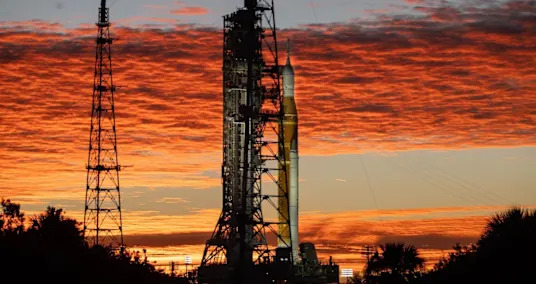
NASA plans to launch its Artemis 2 moon mission from Kennedy Space Center (KSC) in Florida today (April 1) at 6:24 p.m. EDT (2224 GMT). You can watch the liftoff live here at Space.com, beginning at 12:50 p.m. EDT (1650 GMT), and get updates via our Artemis 2 liveblog.
And you really should tune in, for Artemis 2 will do something the world hasn't seen in more than half a century.

Artemis 2 will use a Space Launch System (SLS) rocket to send four astronauts — NASA's Reid Wiseman, Victor Glover and Christina Koch, and Canada's Jeremy Hansen — on a 10-day trip around the moon and back to Earth in an Orion capsule.
No humans have ventured to lunar realms — or even beyond low Earth orbit (LEO) — since NASA's Apollo 17 moon-landing mission in December 1972.
All of the Apollo astronauts were also white American men, so Artemis 2 will make some demographic history as well: Glover, Koch and Hansen will become the first person of color, first woman and first non-American, respectively, ever to travel beyond LEO.

As its name suggests, Artemis 2 will be the second mission in NASA's Artemis program of moon exploration. Artemis 1 sent an uncrewed Orion to lunar orbit and back in late 2022.
Like that previous mission, Artemis 2 is a test flight, designed to show that Orion is capable of supporting astronauts for an extended period in deep space. It will mark the capsule's crew-carrying debut and third spaceflight overall, after Artemis 1 and an uncrewed test mission to Earth orbit in 2014.

NASA will notch yet more milestones on Artemis 3, a 2027 mission to Earth orbit that will test Orion's ability to dock with one or both of the Artemis program's crewed moon landers (SpaceX's Starship and Blue Origin's Blue Moon, both of which are still in development).
And, if all continues going to plan, NASA will land astronauts near the moon's south pole on Artemis 4, which is currently targeted for late 2028. The agency will keep sending crewed and robotic missions back to the area, building up a base and learning how to live and work far from Earth — knowledge that will help the agency make the next giant leap to Mars in the 2030s or 2040s, the thinking goes.
That sustained, increasingly ambitious activity will mark a big difference from the Apollo days. Back then, NASA just wanted to put boots on the moon before the Soviet Union did in order to demonstrate technological superiority over its space race rival. The big push was to put down flags and footprints, not build a base.
So, while today's launch will evoke Apollo for many viewers, it's really about the future — charting a path through deep space that humanity has not yet taken.
LATEST POSTS
- 1
 Opening Potential: Self-awareness and Long lasting Learning
 - 2Iran war pushes Germany's deficit to 4.2% as growth outlook is cut by 50%
- 3When faith comes under fire: How Iran’s repression of religious minorities has increased
- 4Going with Children: Tips for Tranquil Family Get-aways
- 5Sophie Kinsella, 'Confessions of a Shopaholic' author, dies at 55 after battle with cancer




- SpaceX launches Italian Earth-observing satellite to orbit on the 1st mission of 2026 (video)
- Step into Nature: A Survey of \Handling Trails with Solace\ Climbing Shoes
- New Gaza militia declares war on Hamas: 'Your dirty shoes are more honorable'
- Germany raises prospect of military forces to secure Ukraine peace
- This Overlooked Predator Is Running Out of Time—Why Conservationists Are Racing to Save the Striped Hyena
- Higher cost, worse coverage: Affordable Care Act enrollees say expiring subsidies will hit them hard
- From Modesty to Administration: Self-improvement in Interactive abilities
- James Webb Space Telescope watches our Milky Way galaxy's monster black hole fire out a flare
- The Magnificence of Do-It-Yourself Skincare: Regular Recipes and Tips