When you buy through links on our articles, Future and its syndication partners may earn a commission.

At 2:23 am Eastern time on March 19, 2025, an astronaut aboard the International Space station (ISS) captured a striking nighttime view of Earth, where shimmering moonlight dances across dark ocean waters while clusters of city lights outline the Florida Peninsula, the Caribbean, and parts of Central America.
Dense clusters of illumination trace major population centers, including the bright corridor from Miami to Fort Lauderdale along Florida's southeastern coast, the Tampa–St. Petersburg area on the Gulf Coast, and the Orlando metropolitan region near the center of the peninsula. Smaller but still discernible patterns of light mark the Florida Keys, Nassau in the Bahamas, and Havana and other cities across Cuba.
What is it?
Besides the stunning city lights, what sets this image apart is the presence of moonglint, the nighttime counterpart to sunglint. Much like sunlight reflecting off the ocean's surface during the day, moonglint occurs when moonlight reflects off water at just the right angle to reach the observer.
In this case, the observer was a crewmember on the ISS, orbiting hundreds of miles above Earth. At the time, the moon was in a waning phase and about 78% illuminated, bright enough to produce a concentrated reflection across the sea, especially near the Florida Keys and Cuba.
The photograph was taken using a Nikon Z9 digital camera with a 28-millimeter lens, giving a wide field of view similar to that of the human eye. This perspective allows viewers to appreciate the curvature of the planet, accentuated by a thin, faint green layer of airglow along the horizon, a reminder of Earth's atmosphere glowing softly against the darkness of space.
Where is it?
This photo was taken aboard the ISS, around 248 miles (400 kilometers) above Earth.

Why is it amazing?
Nighttime images of Earth reveal patterns of human settlement, infrastructure, and land use that are difficult to capture during the day. Scientists use such observations to study urban growth, energy consumption, and light pollution, while also tracking how human activity intersects with natural environments.
The appearance of moonglint is especially valuable for researchers. Reflections of moonlight off the ocean can help scientists study sea-surface conditions, such as roughness and wave patterns, even at night. When combined with other data sources, these observations improve understanding of ocean–atmosphere interactions and refine models used in climate and environmental research.

The image shows the difference in temperature between the top of a hurricane and the bottom.

The images reveal the storm's incredible power and offer vital insights into how such hurricanes form.

A powerful geomagnetic storm created a series of brilliant auroras recently for observers across North America.
Want to learn more?
You can learn more about airglow and the International Space Station
LATEST POSTS
- 1
 Sydney Sweeney is returning in 'The Housemaid's Secret': What to know about 'The Housemaid' sequel
 - 2Manual for Financial plan Agreeable PC
- 3NASA, in a rare move, cuts space station mission short after an astronaut's medical issue
- 4A definitive Manual for the 5 Off-road Bicycles Available
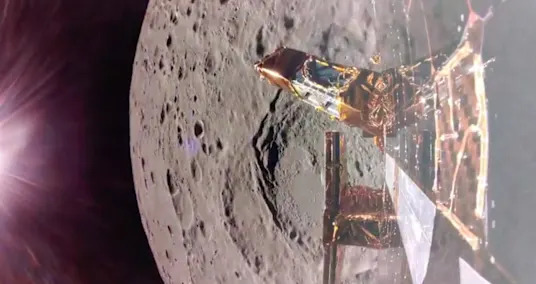
- 51st results from Blue Ghost lunar lander reveal how much we still don't know about the moon


- Trump said affordability is a ‘hoax’ in his Pennsylvania speech. What do the latest numbers show?
- My Dad Can't Travel Like He Used to, but Slowing Down Doesn't Mean Stopping
- Takeaways from AP’s report on potential impacts of Alaska’s proposed Ambler Access Road
- CDC pauses dozens of types of lab testing during evaluation and in wake of downsizing
- Untamed life Safe-havens All over the Planet Offering Remarkable Creature Experiences
- We may have one thing in common with jellyfish, new research finds
- ‘Integral part of our nation’: Herzog visits Franciscan Sisters in Jerusalem ahead of Christmas
- Computerized Strengthening d: A Survey of \Upgrading Efficiency\ Programming Application
- IDF struck Iran's largest petrochemical plant, second facility hit in two days, Katz confirms